Date: 14 April 2026 Event: Executive Workshop on Organisational Culture Location: Manchester Speaker: Dr Vanessa Pozzali, COO and co-founder of Synthosys
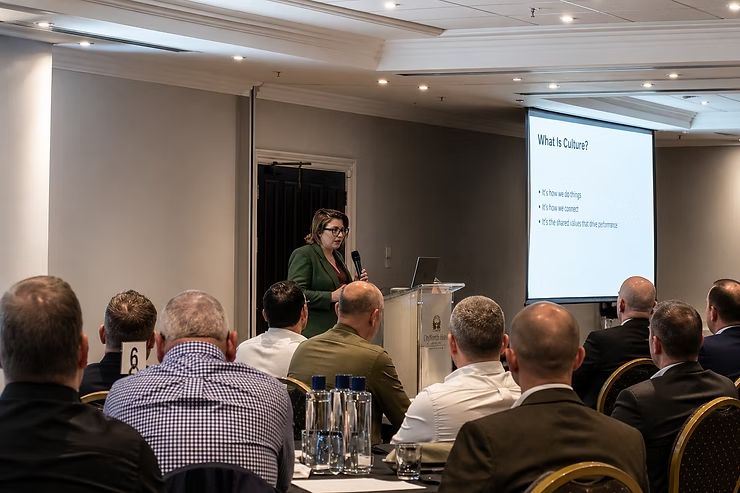
At an executive reflection event in Manchester, Dr Vanessa Pozzali from Synthosys led a large-scale workshop on organisational culture for an international company operating across multiple countries and high-risk environments.
The session brought together around 100 to 150 senior leaders and focused on a problem many organisations still underestimate: why strong values on paper do not always translate into consistent behaviour in practice.
That gap matters. It affects communication, execution, trust, safety, and performance. It also explains why organisations can look aligned at the top while daily behaviour tells a different story lower down.
Culture is what people repeat
The workshop began with a familiar question: what is culture?
Leaders initially described culture through the usual lenses: behaviours, traditions, values, rules, and ways of working. All of that is true. But the discussion then moved to a more practical definition.
Culture is not only what is written. It is what gets repeated, tolerated, and reinforced over time.
That shift helped the room move away from a static view of culture and towards a more useful one. Culture is not a booklet. It is a pattern.
One of the key reflections from the session was that culture often becomes invisible to insiders. New joiners tend to spot it first. They ask why things are done a certain way. The answer they often hear, because we have always done it like this, is usually a sign that behaviour has become embedded without much reflection.
The same organisation can feel different to different teams
Vanessa then introduced a practical framework for understanding culture through four orientations: Control, Connect, Create, and Compete.
As leaders reflected on their organisation, a clear picture began to form. There was a strong presence of structure and stability. There was also a strong relational element built around values and connection. Adaptability showed up in problem-solving. Competitive energy appeared more clearly in selected functions.
The important point was simple: culture is not uniform across an organisation.
Different teams can live very different versions of the same company culture. That matters because leaders often assume alignment based on what is stated centrally, while daily experience varies widely across departments, locations, and layers of leadership.
What sits behind culture
Vanessa introduced four conditions that influence whether an organisation’s culture supports effective work.
Collaboration
How openly people exchange ideas and work together.
Clarity
Whether expectations and decisions are understood.
Consistency
Whether standards and behaviours are applied reliably.
Consolidation
Whether teams remain aligned around shared direction.
The conversation moved from broad cultural values to the conditions that make those values real in daily work.
When culture becomes an operational issue
Because the organisation operates in high-risk environments, the conversation quickly moved beyond culture as a soft topic.
The connection between trust, silence, and safety was central.
When trust is weak, people say less. When people say less, risk stays hidden. When risk stays hidden, safety and performance suffer.
In that context, speaking up is not optional. It is part of how safe organisations function.
This made the workshop highly practical. Culture was not discussed as an abstract leadership theme. It was discussed as an operational issue with real consequences.
Where alignment breaks down
One of the most useful parts of the session came through the group work.
Leaders were asked to reflect on the culture they actually experience, not just the one they aspire to. A recurring issue quickly surfaced: a break in the leadership chain.
At senior level, there was visible alignment. Further down the organisation, especially closer to operations, that alignment weakened. This created inconsistency, fragmentation, and possible safety risks.
That insight mattered because it named a common organisational problem very clearly. Many companies do not fail because leaders disagree at the top. They struggle because intent does not cascade cleanly into behaviour.
At one point, two tables had to share a single flipchart. The instruction sounded simple: share the flipchart. What followed was revealing. Each table interpreted the instruction differently. No common structure emerged. No consistent coordination followed. That small moment became a live example of a much bigger organisational pattern.
High-level intentions such as collaborate, listen, or communicate well sound clear until people try to act on them. Without behavioural clarity, people fill in the gaps differently. That is when execution starts to drift.
Turning values into behaviour
Towards the end of the workshop, participants identified the qualities they wanted more of in leadership: communication, listening, attentiveness, sensitivity.
But when asked what those qualities actually look like in practice, the answers became less clear. That is where many organisations get stuck.
They can name the values. They can describe the intention. But they cannot always translate those intentions into repeatable behaviour.
And when behaviour stays vague, culture becomes inconsistent.
Culture does not change because leaders agree on the right values. It changes when those values are translated into visible, repeatable behaviour across the organisation.
That was the heart of Vanessa’s session in Manchester. Strong leadership, strong values, and high-level alignment are important. But they are not enough on their own.
If behaviour is left open to interpretation, execution fragments. If execution fragments, performance and safety are exposed.
At Synthosys, this is exactly where the work begins: helping organisations move from abstract values to observable behaviour, so leaders can spot misalignment early and strengthen the conditions that make performance sustainable under pressure.